Best Monitors for DSLR Cameras: Essential Field Displays for Sharp Playback
For DSLR enthusiasts and professional shooters, a reliable field monitor is key to accurate exposure, focus, and color on set. This guide highlights five top monitors that pair well with most DSLR systems, offering bright screens, advanced video assist tools, and versatile inputs. Each entry includes a quick overview, plus a buying guide to help you choose the right model for your workflow.
| Product | Brand | Screen | Key Features |
|---|---|---|---|
| FEELWORLD S55 V3 6 inch Field Monitor | FEELWORLD | 6 inch, 1920×1080 | 4K HDMI input/output, LUT support, peaking, focus assist |
| NEEWER F700 7″ Field Monitor | NEEWER | 7 inch, 1920×1080 | 2000 nit brightness, 4K loop in/out, 3D LUTs, waveform/histogram |
| FEELWORLD FW759 7″ Monitor | FEELWORLD | 7 inch, 1280×800 | Slim design, HDMI 4K support, portable for rigs |
| NEEWER F700 7″ Field Monitor + Batteries | NEEWER | 7 inch, 1920×1080 | Includes 2 NP-F750 batteries, 3D LUTs, 4K HDMI loop |
| Desview R6 5.5″ Monitor | Desview | 5.5 inch, 1920×1080 | 2800 nit brightness, HDR waveform, 3D LUTs |
Below are five selected monitors tailored for DSLR use, each offering strong visibility, vital video assist tools, and flexible connections for field shooting. Read on to compare features and determine which model best fits your shooting style and setup.
FEELWORLD S55 V3 6 Inch Field Monitor

The FEELWORLD S55 V3 delivers a compact 6-inch full HD display with a bright, clear image. Its 1920×1080 resolution suits handheld and gimbal setups when a built-in viewfinder is not available. This model supports loading custom LUTs for real-time previews and includes essential video assist tools such as waveform monitoring, false color, zebra exposure, and focus peaking. With 4K HDMI input/output, it can connect to DSLRs, camcorders, or larger on-set displays for immediate review. Compatible with external power options for longer shoots.
NEEWER F700 7″ Field Monitor

The NEEWER F700 stands out with up to 2000 nits of brightness on a 7 inch IPS touchscreen, ensuring visibility under bright outdoor light. It features 4K HDMI in/out, 3D LUT support, and a suite of professional monitoring tools including waveform, vectorscope, and histogram. The unit offers a user-friendly interface with shortcut controls and an option to upload up to 60 custom LUTs plus firmware upgrades via SD card, making it adaptable to various color workflows.
FEELWORLD FW759 7 Inch Monitor
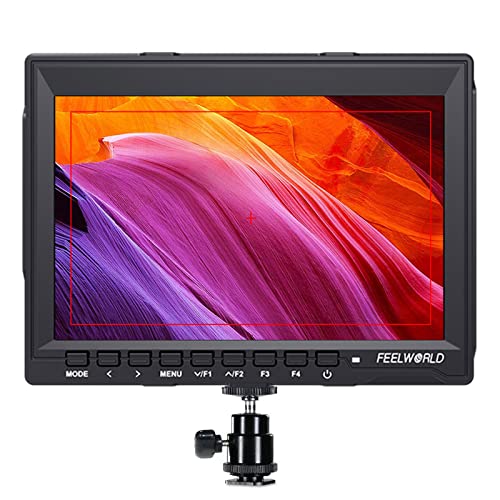
The FW759 provides a slim, portable option with a 7-inch display and 1280×800 resolution. Though lighter on pixel count, it remains a practical on-the-go monitor for stabilizers and gimbals, offering HDMI input with 4K support and compatibility with a broad range of DSLRs and camcorders. Its compact profile makes it ideal for travelers and shooters who prioritize portability without sacrificing essential monitoring capabilities.
NEEWER F700 7″ Field Monitor With Batteries

This variant of the F700 includes a pair of NP-F750 batteries and a compatibility kit, providing extended field runtime. It shares the 2000-nit brightness and full 1920×1080 IPS panel with comprehensive 3D LUT support, false color, peaking, and HDR tools. The 4K HDMI loop in/out remains valuable for on-set review, while the headphones jack enables monitoring without disturbing the crew.
Desview R6 5.5 Inch Monitor

The Desview R6 is a compact 5.5-inch field monitor designed for bright outdoor shoots. It delivers 1920×1080 resolution with a 2800 nits brightness rating, ensuring legible imagery in challenging lighting. It includes 3D LUT support, HDR monitoring tools like waveform and vectorscope, plus a true 4K HDMI input with loop-out. The device complements DSLR rigs requiring a portable, high-contrast screen and reliable exposure tools in tight spaces.
Buying Guide
- Brightness and readability: For outdoor use, prioritize high brightness (1000+ nits) and a transflective or high-contrast panel to maintain visibility in sunlight.
- Resolution vs. size: A larger screen (7 inches) with 1080p or better provides more accurate focus and framing, though smaller monitors like 5.5 inches can reduce weight on handheld rigs.
- Video assist tools: Look for features such as waveform, vectorscope, histogram, false color, zebra, peaking, and LUT support to streamline exposure and color decisions on set.
- Inputs and outputs: Ensure HDMI (preferably 4K capable) with loop-in/out helps you monitor multiple devices or feed to on-set displays. Consider SD card firmware updates for LUTs and presets.
- Power options: compatibility with common battery types (NP-F, LP-E6, or DC input) supports longer shoots and flexible power setups.
- Build and portability: For gimbal work, prioritize slim profiles, light weight, and sturdy mounting options; a tilt arm can improve viewing angles.
- Color accuracy and calibration: Look for monitors with Rec.709 or other standard color spaces and mention of factory calibration to ensure reliable skin tones and color grading data on set.
- Durability and accessories: Cases, sun hoods, and included mounts or brackets add value, especially for field production and travel.