Best Light Meter for Camera to Enhance Your Photography
Choosing the best light meter for cameras is essential for photographers aiming to capture perfectly exposed images, whether shooting film or digital. Light meters help measure the light intensity in the environment, guiding aperture, shutter speed, and ISO settings for ideal exposure. This article reviews top-rated light meters with distinct features like accuracy, ease of use, and compatibility with various camera types. Below is a summary table highlighting key attributes of the selected products.
| Product | Brand | Type | Features |
|---|---|---|---|
| URCERI Digital Illuminance Meter | URCERI | Digital Lux Meter | Measures 0-200,000 Lux, ambient temperature, color LCD, high accuracy |
| LightMate AirPro Light Meter | LightNova | Reflective Digital Exposure Meter | 35° wide angle, ±0.1EV accuracy, 3 dials for aperture/ISO/shutter |
| LightMate Lite 2R Light Meter | LightNova | Ambient Light Digital Meter | High precision, large OLED screen, rechargeable, exposure compensation |
| Sekonic 401-208 Twin Mate | Sekonic | Analog Light Meter | Instant aperture/shutter readout, camera shoe mount, one-hand operation |
| Sekonic L-308X-U Flashmate | Sekonic | Ambient and Flash Light Meter | Accurate to 1/10 stop, ambient and flash readings, shutter/aperture priority |
URCERI Digital Illuminance Meter with Large LCD Screen
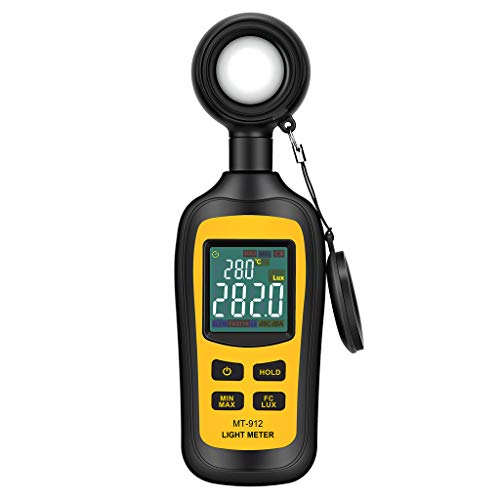
The URCERI Digital Illuminance Meter excels in capturing lighting details for both professional and hobbyist photographers. It can measure light intensity from 0 to 200,000 Lux and also tracks ambient temperature. Featuring a 4 digit color LCD screen for easy visibility, it delivers high accuracy within ±3% for readings under 10,000 Lux. This device supports functions like MIN/Max light readings, data hold for stable measurement observation, auto power-off to save battery, and a low battery indicator. Its design makes it a versatile handheld tool not limited to photography but useful in varied lighting applications.
LightMate AirPro Reflective Digital Exposure Meter

The LightMate AirPro offers professional-grade photographic metering with its 35° wide-angle reflective sensor designed to mimic human eye perception. It boasts a precise ±0.1 EV metering accuracy and covers ISO settings from 1 to 3200, shutter speeds from 60s down to 1/8000s, and apertures from f/1 to f/64. Users can navigate multiple modes including aperture priority, shutter speed priority, manual, and EV mode. The meter includes tactile feedback dials for aperture, ISO, and shutter speed, featuring half-stop resolution with options for 1/3 or 2/3 stops, making it ideal for analogue camera enthusiasts who demand exact exposure control.
LightMate Lite 2R Compact OLED Digital Exposure Meter

The LightMate Lite 2R balances compactness and advanced exposure metering. It features a 0.96 inch large OLED screen and a 30° field of view sensor, tailored for precise ambient light measurement in diverse shooting environments. With a rechargeable battery supporting 20 hours of active use and standby capabilities exceeding 6 months, it caters to on-the-go photographers. The meter supports exposure compensation, ND filter compensation, and depth of field calculations. The device’s screen brightness is adjustable to improve readability outdoors, combined with multiple metering modes (single, automatic, and averaging), assuring flexibility for film camera users and digital alike.
Sekonic 401-208 Twin Mate Classic Light Meter
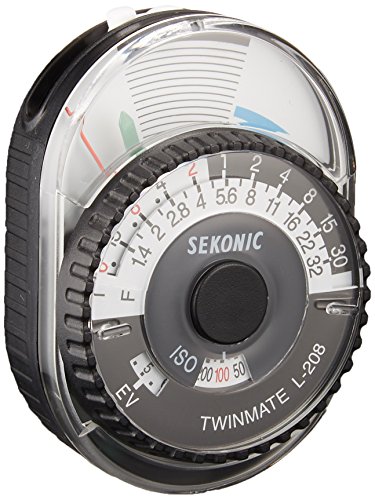
The Sekonic 401-208 Twin Mate is a traditional analog light meter known for its instant aperture and shutter speed combination reading via its dial ring. Its unique feature is its capability for one-hand operation and camera shoe mounting, allowing photographers to meter light conveniently during shooting. This reliable device caters to photographers who prefer manual exposure determination without digital screens, emphasizing simplicity and rapid adjustment. Its durability and straightforward design make it a classic companion for film cameras or vintage camera setups.
Sekonic L-308X-U Flashmate for Ambient and Flash

The Sekonic L-308X-U Flashmate blends ambient and flash metering in one compact device, capable of exposures accurate to a tenth of a stop. It covers an ambient EV range from 0 to 19.9 at ISO 100 and a flash f-stop range from f/1.0 to f/90.9. The shutter speeds it supports span from 60 seconds to 1/8000 while featuring dedicated photo modes allowing shutter or aperture priority displays. Its cordless and corded flash measurement capabilities support diverse studio and field photography, enhancing exposure precision for advanced photographers.
Buying Guide: How to Choose the Best Light Meter for Your Camera
Selecting the right light meter depends on your photography style, camera type, and exposure requirements. Here are vital factors to consider:
- Metering Type: Decide between incident light meters measuring light falling on a subject, and reflective meters gauging light bouncing off surfaces. Incident meters are more accurate for portraits and studio, while reflective meters are portable and suitable outdoors.
- Compatibility: Ensure the meter supports your camera’s ISO range and metering modes, especially if you use film cameras or manual controls on digital systems.
- Display and Ease of Use: Digital meters usually provide clearer numerical readings on LCD or OLED screens. Analog meters offer simplicity but may require interpretation.
- Accuracy and Range: Check the meter’s EV or Lux range and its accuracy tolerance. High precision is crucial for professional work and challenging lighting situations.
- Power Options: Consider rechargeable meters for frequent use or models with replaceable batteries for long life without charging downtime.
- Additional Features: Useful extras include exposure compensation, ND filter correction, flash metering capability, and data hold functions.
- Portability and Build Quality: A compact, lightweight meter is preferable for fieldwork, while sturdy construction ensures durability.
By balancing these considerations with your budget, you can find a light meter that optimizes your exposure precision and complements your shooting style.