Best Heavy Duty Professional Tripod for Pro Filmmaking
Choosing a heavy duty professional tripod means prioritizing stability, load capacity, and versatile movement for demanding shoots. The following hand-picked models offer rugged aluminum builds, comfortable height ranges, and fluid head performance to support cameras, camcorders, or even telephoto optics. This guide compares five top options to help you pick a reliable, long-lasting tripod for studio, outdoor, and field work.
| Product | Height Range | Max Load | Key Feature |
|---|---|---|---|
| NEEWER 79″/200cm Video Tripod | 34.6″ to 78.7″ | 8 kg / 17.6 lb | 360° fluid drag head; 70mm bowl |
| JOILCAN Tripod 74″ | 19.5″ to 74″ | 15 lb | Lightweight with quick-release plates and phone holder |
| Victiv 78″ | 18.5″ to 85″ | 31 lb | 360° pan, 90°/ -70° tilt, 4-section aluminum legs |
| CAMBOFOTO 74″ Aluminum Tripod | 20″ to 74″ | 8.8 lb | 360° pan head, multi-device compatibility |
| MACTREM 84″ | 18.5″ to 84″ | 33 lb | 360° swivel ball head, monopod conversion |
Each option emphasizes stability, quick height adjustment, and compatible mounting hardware. Whether you shoot weddings, action sports, or nature photography, a reliable heavy duty tripod reduces shake and improves framing in varying terrains.
NEEWER 79″/200cm Video Tripod Review

The NEEWER heavy duty aluminum tripod supports cameras and camcorders up to 8 kg (17.6 lb) with a 70 mm bowl base for stable leveling on uneven surfaces. It extends from 34.6 inches to 78.7 inches and folds to 35.8 inches for transport. A robust flip-lock system makes height changes quick, and the large 1/4″ and 3/8″ screws on the quick release plate ensure broad compatibility with Canon, Nikon, Sony, and other major brands.
JOILCAN 74″ Tripod for Cameras and Phones

JOILCAN’s 74-inch tripod combines light weight with strong stability, featuring 18″ compact size and a 3.15 lb build. It offers upgraded trapezoidal lock mechanisms for quick height adjustments, a quick-release plate, and a phone holder for easy use with smartphones. The tripod is compatible with a wide range of devices via standard 1/4″ screws, making it suitable for cameras, camcorders, and accessories.
Victiv 78″ Aluminum Tripod with Monopod

The Victiv tripod reaches up to 78 inches and can convert to an 85-inch monopod. It features four-section aluminum legs, a 360° pan head, wide stance, and non-slip rubber feet for stability on varied terrains. The head tilts from -70° to +90°, while a 1/4″ quick release plate ensures rapid setup with DSLRs, camcorders, and optics.
NEEWER 74″ Video Tripod with Fluid Head

This NEEWER TP74 model provides a fluid drag pan head with 360° rotation and -75°/ +90° tilt. It supports up to 8 kg and uses a 75 mm bowl for steady, panoramic shots. The dual quick-release modes offer compatibility with various plates, including DJI RS series and Manfrotto plates, simplifying transitions between tripod setups and gimbals.
MACTREM 84″ Camera Tripod
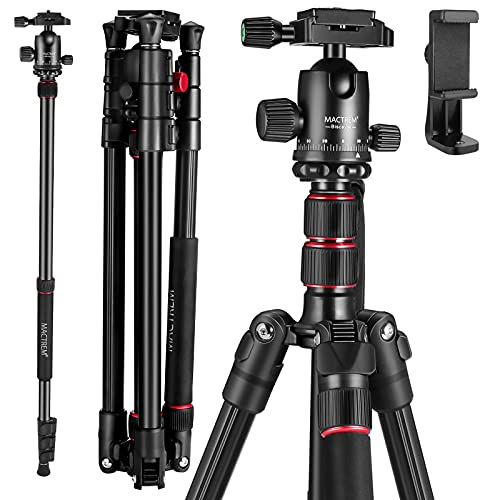
MACTREM’s 84-inch tripod is lightweight for its size, enabling travel with a 1.6 kg body and up to 15 kg (33 lb) load capacity. It can transform into a monopod, offers a 360° swivel ball head, and includes a carrying bag for portability. The design emphasizes a stable stance with reliable leg locks and a wide height range to cover low- and high-angle shots.
CAMBOFOTO 74″ Aluminum Tripod

CAMBOFOTO’s 74-inch tripod uses durable aluminum legs with a 360° pan head and a quick release plate, plus a phone mount for hybrid setups. It supports up to 8.8 pounds, making it suitable for DSLRs, mirrorless cameras, smartphones, and entry-level camcorders. The compact design and straightforward assembly favor travel and everyday shooting scenarios.
Buying Guide
- Weight capacity and stability: Prioritize tripods that clearly state their maximum load in pounds or kilograms, and ensure the head design (fluid drag vs. fixed) matches your shooting style and camera weight.
- Height range and portability: Consider models that offer both a high maximum height and a compact folded length for travel. Look for flip-locks or twist-locks that suit your workflow.
- Head type and movement: Fluid heads provide smooth panning and tilting for video, while ball heads offer quick framing for photography. A 360° pan capability is beneficial for panoramic shots.
- Mounting compatibility: Ensure the quick release plate has standard 1/4″ and 3/8″ screws and a compatible bowl size for your camera plate. Some models offer quick-switch plates for gimbals or accessories.
- Monopod conversion and versatility: Some tripods convert to monopods, which can be valuable for long shoots or uneven terrain. Check how easily the center column or legs convert.
- Materials and durability: Aluminum tripods strike a balance between weight and stability. Heavier metal builds often offer better stability in windy environments but may be less portable.
- Transport and storage: Look for a carrying bag, shoulder strap options, and compact folding lengths that fit your vehicle or airline requirements.
- Accessory compatibility: If you use smartphones, ring lights, or small rigs, ensure the tripod supports devices beyond traditional cameras (via standard screws and mounts).