Best Dash Cams With Front Cameras for Cars
Finding the right dash cam with a front camera helps capture clear driving footage, improve safety, and provide reliable evidence in case of incidents. This guide highlights five top front-camera dash cams, detailing their key features, recording modes, and ease of use. Each option prioritizes high-resolution front recording, robust night vision, and reliable parking protection to support everyday driving and unexpected events alike.
The following overview showcases five strong choices for American drivers, balancing image quality, storage, and practical features like GPS, Wi-Fi, and parking monitoring. Use the quick product snapshot below to compare essentials at a glance.
| Product | Brand | Key Front-View Feature |
|---|---|---|
| TERUNSOUl 4K+4K Dash Cam Front and Rear | TERUNSOUl | Front 4K with ultra-wide 170° lens |
| ROVE R2-4K DUAL Dash Cam | ROVE | 4K front recording with 150° FOV |
| REDTIGER 4K Dash Cam Front Rear | REDTIGER | 4K front with 170° FOV |
| FAIMEE 4K+2K+2K 3-Channel Dash Cam | FAIMEE | Triple-channel with 4K front |
| Veement 1296P Dash Cam | Veement | 1296P front with 170° view |
TERUNSOUl 4K+4K Dash Cam Front and Rear
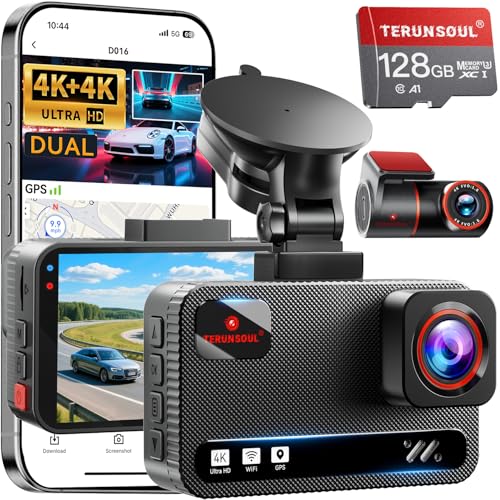
Dual-channel 4K recording captures both the road ahead and behind in 3840×2160P, ensuring high-detail evidence. The front camera uses a 170° ultra-wide lens, while the rear camera contributes to six-lane coverage. Includes a pre-installed 128GB card for immediate use and supports up to 512GB for extended storage. Loop recording maintains continuous footage, and a G-sensor locks critical events to prevent overwriting. Night vision benefits from a larger F1.5 aperture on the front and an F1.8 on the rear, enhancing low-light clarity.
ROVE R2-4K DUAL Dash Cam Front and Rear

This 4K front and 1080P rear setup features a Sony STARVIS 2 sensor for vivid daytime and superb night recordings. The front camera offers a 150° field of view, with a 140° rear for broader coverage. Built-in dual-band WiFi enables fast app-based downloads of footage, while a G-sensor triggers emergency recording on impact. The system is designed to deliver easy sharing and quick review via the app, with up to 20 MB/s transfer speeds for smooth playback and transfer.
REDTIGER 4K Dash Cam Front Rear

Featuring a 4K front and 1080P rear with STARVIS 2 sensor, this dash cam delivers high-contrast imagery and clear night footage. The front F1.5 lens and a second camera with F1.8 aperture maximize light intake, helping record legible license plates in low light. A built-in 5.8GHz WiFi enables fast app-based management, GPS logging, and easy sharing, while the 170° front and 140° rear angles reduce blind spots for comprehensive coverage.
FAIMEE 4K+2K+2K 3-Channel Dash Cam
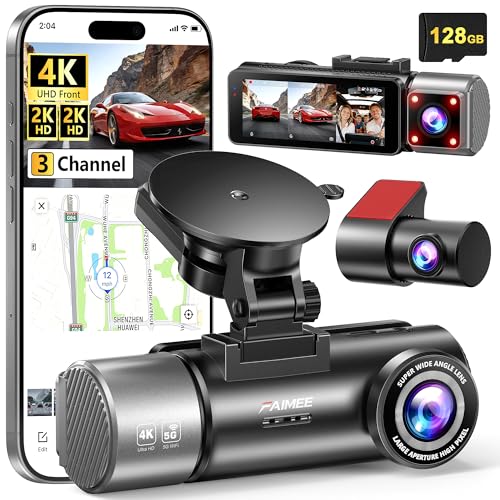
Triple-channel recording combines 4K front with 2K cabin and 2K rear to deliver a near 360° view. A pre-installed 128GB card starts you off, with G-sensor collision locking and loop recording to manage footage. The system supports time-lapse parking mode for continuous protection while parked. Its 170° front and 150° rear wide angles minimize blind spots, enhancing evidence quality for accidents or fraud investigations.
Veement 1296P Dash Cam Front and Rear

High-definition 1296P front recording with a 170° wide lens offers clear daytime footage and improved night performance. The 3.39″ touchscreen provides intuitive controls, while a G-sensor enables emergency locking of footage on impact. The dash cam supports looping recording and a parking mode, with a 64GB card included for immediate use. Its minimalistic design aims for broad compatibility with various vehicle types.
Buying Guide: Front-Camera Dash Cams
Key decision factors when choosing a dash cam with front camera:
– Resolution and image quality: Higher front resolution improves license-plate readouts and detail, especially at speed and in low light.
– Field of view: A wider front angle reduces blind spots but may introduce distortion; balance with driving needs.
– Night vision: Look for large apertures (F1.5–F1.8) and WDR/HDR to handle high-contrast scenes.
– Storage and memory: Preloaded cards help immediate use; verify capacity and loop recording to avoid overwriting important clips.
– Parking features: 24H parking with motion or time-lapse recording adds protection when the vehicle is unattended.
– Connectivity: WiFi or app support speeds up footage transfer and GPS data review.
– Reliability: G-sensor, GPS logging, and emergency locking ensure critical events are preserved for police, insurance, or claims.
– Installation and compatibility: Check size, mounting options, and power requirements for your vehicle type.
– Firmware updates: OTA updates help maintain performance and fix potential issues over time.
Pros and cons across typical models:
– 4K front, dual channels: Best detail; higher storage needs; may increase power consumption.
– Trip- or multi-channel: Better coverage but more complex setup and data management.
– Built-in GPS: Valuable for route data and speed in investigations; ensure accurate timestamping.
– Ease of use: Touchscreens and app control simplify playback and sharing but may add cost.
– Price vs. features: Prioritize features that align with your driving needs and legal requirements in your state.