Best 24-70mm Lenses for Sony and Canon: Versatile Zooms for Any Shoot
Choosing a 24-70mm lens means seeking a versatile workhorse that covers wide to short-telephoto perspectives with a consistent aperture. The following selection includes renowned options from Sony, Canon, Sigma, and Rokinon, spanning full-frame compatibility and various feature sets. This guide compares performance traits, build quality, and image characteristics to help you pick a lens that fits your camera system and shooting style.
| Brand | Model | Mounting | Key Benefit |
|---|---|---|---|
| Sony | SEL2470GM FE 24-70mm F2.8 G Master | Sony E | High resolution, fast DDSSM autofocus |
| Canon | EF 24-70mm f/2.8L II USM | Canon EF | Pro-grade image quality, robust build |
| Canon | EF 24-70mm f/2.8L USM | Canon EF | Classic design, reliable performance |
| Sigma | 24-70mm f/2.8 DG OS HSM Art | Canon EF | Optical stabilization, strong performance |
| Rokinon | 24-70mm F2.8 AF Zoom | Sony E | Constant f/2.8, cinematic features |
Note: All models listed below are compatible with their stated mounts and designed for full-frame formats. Focus performance, stabilization, and weight vary by model and camera body, so verify compatibility with your system before purchase.
Sony Sel2470gm E-Mount Lens Overview

The Sony SEL2470GM is a high-performance, full-frame standard zoom designed for advanced imaging with the Sony E-mount. It features a Direct Drive Super Sonic Wave Motor (DDSSM) for rapid autofocus and a focus hold button for quick manual override. The lens achieves lifelike texture with ED and Super ED glass elements and minimizes aberrations using two aspherical components and an XA element. Note that image stabilization is not built-in, so stabilization must come from the camera or a stabilized body profile.
Canon EF 24-70mm f/2.8L II USM

This Canon EF 24-70mm f/2.8L II USM standard zoom delivers a constant f/2.8 aperture across the zoom range along with exceptional image quality and robust L-series build. Its 24-70mm focal length is well-suited for events, landscapes, and portraits. The lens supports full-time manual focus and features a ring-type ultrasonic AF motor for precise focus control. It accepts 82mm filters and has a minimum focusing distance of 0.38 m.
Canon EF 24-70mm f/2.8L USM (Renewed)
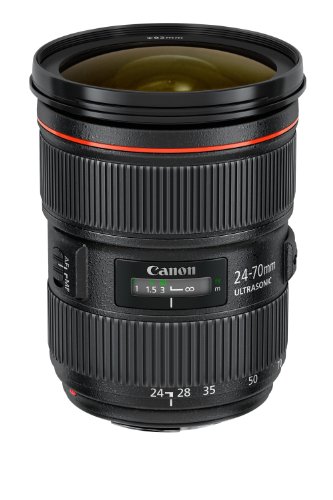
This renewed Canon EF 24-70mm f/2.8L USM offers classic L-series performance at a reduced price point. It retains the large maximum aperture for consistent exposure and subject isolation, with full-time manual focus and aspherical lens elements to optimize sharpness across the frame. The lens is supplied with essential caps, a hood, and a soft case, aiding transport and storage.
Sigma 24-70mm f/2.8 DG OS Art

The Sigma 24-70mm f/2.8 DG OS Art lens emphasizes optical stabilization (OS) and a robust HSM for quick, silent autofocus. The Art lens series is designed for professional use, featuring a rigid barrel and a design that supports high-contrast, sharp imaging across the focal range. This lens is a strong option for Canon EF-mount shooters seeking a versatile all-around performer for both stills and video.
Canon EF 24-70mm f/2.8L USM
This Canon EF 24-70mm f/2.8L USM offers a proven combination of constant f/2.8 aperture, full-frame coverage, and high-quality optics. The lens is designed for Canon SLR cameras, providing reliable performance with full-time manual focus and an aspherical element configuration that contributes to sharpness across the frame. It remains a staple choice for photojournalists and event shooters.
Rokinon 24-70mm F2.8 AF For Sony E

Rokinon’s 24-70mm F2.8 AF Zoom covers the full-frame range with a constant F2.8 aperture. It is designed for Sony E-mount with weather sealing, Par-focal design for video, and a silent operation profile. The lens uses multiple aspherical and low-dispersion elements to minimize aberrations and maintain sharpness across the zoom range, appealing to videographers and hybrid shooters seeking cinematic results.
Canon EF 24-70mm f/4.0L IS USM

The Canon EF 24-70mm f/4.0L IS USM offers a compact, lightweight alternative with image stabilization. While the maximum aperture is smaller at f/4, this lens remains sharp across the zoom range thanks to a design that includes two aspheric and two UD elements. It is suitable for travel and street photography where portability and stabilization are prioritized, with the flexibility of standard zoom range.
Buying Guide: Key Purchase Considerations
When selecting a 24-70mm lens, consider the following perspectives to match your camera system and shooting priorities.
- Mount compatibility: Ensure the lens flange distance and mount type match your camera (Sony E, Canon EF, or other). Adapters can extend compatibility, but native mounts deliver optimal autofocus and stabilization.
- Constant aperture: Lenses with a constant f/2.8 (or similar) across the zoom range provide consistent exposure and depth of field, especially in low light and for video work. Some f/4 options prioritize size and stabilization while sacrificing speed.
- Autofocus and stabilization: Fast, reliable AF motors (DDSSM, USM, HSM) improve action and event photography. Optical stabilization (OS) helps in handheld shooting, but some lenses rely on camera bodies for stabilization.
- Optical performance: Look for high-quality elements (UD/ED, aspherical, XA) that reduce chromatic aberration and distortion. Par-focal designs help maintain focus during zoom for video work.
- Build and weather sealing: Professional-use lenses often feature rugged construction and weather sealing. Weighing durability against weight helps in choosing travel-friendly options.
- Size and weight: Heavier lenses may require better support and technique. If you shoot handheld for extended periods, consider ergonomics and balance with your camera body.
- Price-to-performance ratio: Compare optical quality, autofocus speed, and stabilization against the price to determine overall value for your needs.
- Video considerations: If you shoot video, par-focal performance and silent focusing are valuable features. Look for lenses designed with cinema-like handling and smooth zoom behavior.
- Usage scenario: Event photography benefits from fast AF and luminance performance, while landscapes may prioritize edge-to-edge sharpness and minimal distortion across the frame.
In summary, the best 24-70mm lens choice depends on your camera system, desired balance of speed, stabilization, and portability, as well as whether you prioritize stills or video workflows. The options above span flagship professional models, reliable workhorse primes, and versatile zooms that suit many shooting environments.