Best Wide-Angle Conversion Lenses for Creative Shots
Explore top wide-angle conversion lenses that expand your camera’s perspective, from expansive landscapes to detailed macro shots. This guide compares several popular 2-in-1 designs, highlighting compatibility, image quality, and macro capabilities to help you choose the right attachment for your setup.
| Product | Brand | Thread Size | Macro Ability | Key Benefit |
|---|---|---|---|---|
| SSE 37mm High Definition | SSE | 37mm | Built-in macro | Broad compatibility; sharp optics |
| NEEWER LS-30 40.5mm | NEEWER | Ø40.5mm | 10x macro | 1st-tier macro versatility on Sony APS-C |
| Altura Photo 58mm 0.43x | Altura Photo | 58mm | Macro option with detachable section | Wide compatibility with many Canon/Nikon lenses |
| FotoZ 49mm 0.75x HD | FotoZ | 49mm | Macro included | Mid-range focal options for Canon/RF-M/EC-M |
| NEEWER 18mm for G7X Mark III | NEEWER | Ø40.5? (standard 18mm design) | 10x macro | Optimized for Canon G7X Mark III |
SSE 37mm High Definition Wide Angle Lens

The SSE 37mm High Definition Wide Angle Lens combines a 0.45x ultra-wide with a built-in macro conversion lens in a single 2-in-1 unit. Its 37mm thread makes it widely compatible with many camera bodies and lenses that use a 37mm filter thread. The design emphasizes high-definition optical glass to deliver sharp, low-distortion images, ideal for landscapes, architecture, and close-up details when macro is engaged.
NEEWER LS-30 40.5mm Wide Angle + 10x Macro

Designed for Sony APS-C cameras like the ZV-E10 and ZV-1F, this 2-in-1 lens converts an 18mm wide angle with enhanced 84-degree coverage and provides a 10x macro option when the wide-angle component is removed. The LS-30 is specifically tailored for compatible Sony models and includes a bayonet mount adapter, ensuring quick attachment and reliable macro performance for product photography, jewelry, and micro subjects.
Altura Photo 58mm 0.43x Wide Angle With Macro

The Altura Photo 58mm 0.43x wide-angle lens attaches to a large family of Canon, Nikon, Olympus, Lumix, and more. It expands the field of view while including a detachable macro lens for close-up shooting. It’s compatible with many common Canon/Nikon lenses that use a 58mm thread, making it a flexible option for hobbyists who own multiple bodies or older kit lenses.
FotoZ 49mm 0.75x HD Wide with Macro
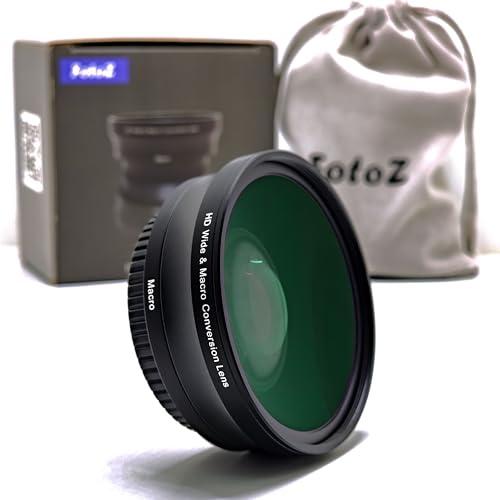
FotoZ’s 49mm 0.75x HD wide-angle lens offers a broader field of view for Canon EOS M series, RF-S kit lenses, and compatible 49mm threads. The integrated macro capability expands close-up photography, allowing macro detailing without changing lenses. It supports multiple camera ecosystems and is designed to maintain autofocus and exposure integrity while delivering clearer edge-to-edge performance.
NEEWER 18mm Wide Angle for Canon G7X Mark III

This NEEWER 2-in-1 accessory converts the Canon G7X Mark III’s native kit into an 18mm wide-angle lens while preserving a 10x macro option when the wide angle is detached. It includes a built-in extension tube to improve macro magnification and reduce sensor crowding, making it suitable for vloggers and close-up shooters who want flexibility without swapping lenses.
Professional 0.45x Wide Angle With Macro (52mm)

Generic 0.45x wide-angle conversion lens with a 52mm filter thread offers a straightforward solution for expanding fields of view on compatible lenses. The macro feature detaches from the front for close-ups, enabling a two-tone approach to landscape and product photography while preserving core autofocus and exposure functions.
Buying Guide
Key considerations
- Thread size and compatibility: Ensure the lens matches your camera’s filter thread (e.g., 37mm, 40.5mm, 58mm, 49mm). Incompatibility often requires adapters, which can affect image quality and autofocus.
- 2-in-1 design: Lenses that integrate both wide-angle and macro functions save space and simplify switching contexts while shooting.
- Optical quality: Look for HD or high-definition optical glass, low distortion across the frame, and minimal chromatic aberration for best results in landscapes and macro work.
- Macro magnification: The macro capability (often up to 10x) determines how close you can shoot small subjects. Check actual magnification specs and usability with your camera’s sensor size.
- Weight and balance: Added front elements can affect handling, especially on compact mirrorless bodies. Consider models with lightweight construction for travel or handheld shooting.
- Ease of attachment: Quick-release or simple screw-on designs help preserve your shooting flow, particularly when you need to switch between modes.
- Image quality vs. price: Premium options tend to deliver sharper edges and reduced distortion, but mid-range lenses still provide solid compromises for hobbyists.
Usage scenarios
- Landscape and architecture: Use wide-angle to capture more of the scene with minimal distortion at supported focal lengths.
- Macro photography: Activate macro mode for close-ups of small subjects—flowers, jewelry, insects—where fine detail matters.
- Content creation: For vloggers and YouTubers, these lenses expand filming options without swapping multiple lenses.
Performance considerations
- Sharpness: Wide-angle sections can be softer at the edges; look for coatings and glass quality that mitigate softness.
- Vignetting and distortion: Some 2-in-1s may introduce vignetting at the corners or barrel distortion; ensure your post-processing workflow can address these.
- Autofocus compatibility: Some adapters or 2-in-1 designs may impact autofocus speed; check user reviews for real-world performance on your camera model.
Selecting a wide-angle conversion lens involves weighing thread compatibility, macro capability, and optical quality against your camera system and shooting needs. The options above provide a spectrum of configurations—from Sony-focused macro adapters to Canon/RF-M compatible designs—so you can find a versatile partner for landscape, architectural, and macro photography without frequent lens swaps.